
Bar soap vs liquid soap
Bar soap and liquid soap clean equally well: but the differences in pH, surfactants, microbiome impact, packaging, and cost are real. Here's the honest comparison.
"Is bar soap or liquid soap better?" is one of the most common questions in personal care, and the honest answer is: it depends on what you're optimizing for. Both can clean skin equally well. The differences are in pH, surfactant chemistry, skin microbiome impact, environmental cost, and cost-per-use. This page walks through the actual differences without picking a winner.
Key findings
- The FDA ruled in 2016 that manufacturers could not market consumer antiseptic washes containing triclosan and 18 other active ingredients, having found no evidence they outperformed plain soap and water.
- The classic 1965 Armed Forces study and subsequent replications have shown that even bars with deliberately contaminated surfaces don't transfer pathogens to washed hands.
- A body wash is skin-neutral in pH and leaves more emollient behind; a traditional saponified bar runs alkaline (pH 7.5-10) and rinses cleaner.
- Body wash is a specific subcategory: a syndet (synthetic detergent) system built for shower use, typically formulated at pH 5-6 with a higher emollient load (glycerin, fatty alcohols, sometimes silicones) to leave more residue on skin after rinsing.
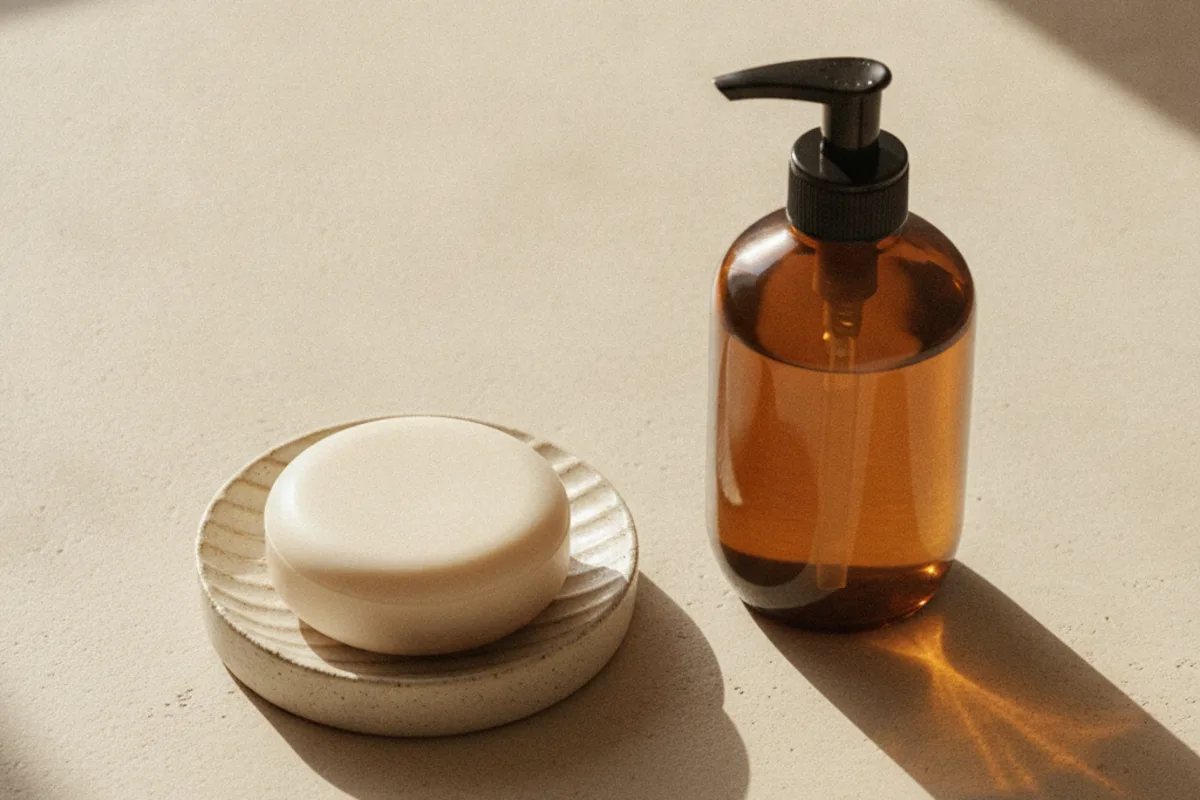
What's in bar soap vs liquid soap
Bar soap
Traditional bar soap is made by saponification, combining fats or oils (tallow, olive oil, coconut oil, palm oil) with an alkali (sodium hydroxide / lye). The reaction creates a sodium salt of fatty acids, which is the soap. Glycerin is a byproduct; many commercial bar soaps strip it out for industrial use, while natural soap makers leave it in. Modern syndet (synthetic detergent) bars use surfactants like sodium cocoyl isethionate instead of saponified oils.
Liquid soap
Liquid soaps are surfactant-based formulations, typically sodium laureth sulfate (SLES), cocamidopropyl betaine, decyl glucoside, or similar. Water is the dominant ingredient. Glycerin is added for moisturization. Preservatives are required (water-based formulas are vulnerable to bacterial growth, unlike bar soap which dries out between uses). Castile-style liquid soaps use potassium-saponified oils, more similar to traditional bar soap chemistry, just in liquid form.
Bar soap vs liquid soap: the real differences
| Dimension | Bar soap | Liquid soap |
|---|---|---|
| Typical pH | 7.5–10 (true soap); 5.5–7 (syndet bar) | 5–7 (most formulations) |
| Preservatives needed | Usually none | Required (water vulnerability) |
| Packaging | Minimal: often paper or no wrapper | Plastic bottle, pump dispenser |
| Cost per use | Lower. Bars last longer per gram | Higher: water makes up most of the volume |
| Travel / shipping | Easier: no liquid restrictions, lighter weight | Harder: TSA 3-1-1, heavier shipping |
| Microbiome impact | Variable: depends on surfactants and pH | Variable: depends on surfactant choice |
| Hygiene perception | Sometimes seen as "less hygienic" (myth: see FAQ) | Perceived as more hygienic |
The "bar soap is unhygienic" myth
A common worry: "bar soap sits in a shower and grows bacteria." The reality, validated in multiple peer-reviewed studies, is that bacteria don't transfer from bar soap to skin in any meaningful quantity. The wash action of soap + water removes the surface microbes faster than they can colonize the skin. The classic 1965 Armed Forces study and subsequent replications have shown that even bars with deliberately contaminated surfaces don't transfer pathogens to washed hands. Bar soap is hygienically safe.
When bar soap is the better choice
- Sensitive skin: true soap bars often have fewer ingredients, no fragrance unless added, no preservatives, and (for tallow- or olive-oil-based bars) gentler surfactants than mass-market liquid soaps.
- Reducing plastic packaging: bars travel without bottles.
- Cost optimization. Bars last 2–3× longer per gram than the equivalent volume of liquid soap.
- Travel: bypasses TSA 3-1-1 rules; doesn't spill in luggage.
- Specialty formulations: tallow-base soaps, prebiotic donkey-milk soaps, calamine-containing bars all live in the bar format.
When liquid soap is the better choice
- Public-shared bathrooms: pump dispensers reduce cross-contact even though the bacterial risk from bars is essentially zero in practice; perception still matters.
- Kitchen sinks / hand wash stations: dispensers are faster and cleaner for high-frequency hand washing.
- Children: easier to dispense, less likely to be dropped.
- Specific actives: some actives (certain peptides, exfoliating acids) are easier to formulate into liquid surfactant systems than into a saponified bar.
Bar soap vs liquid soap and the skin microbiome
Both bar and liquid soaps can disrupt the skin microbiome depending on the surfactant strength and pH. A harsh syndet liquid soap and a harsh sodium lauryl sulfate bar soap both strip skin barrier lipids equally. A gentle saponified tallow bar (like WhollyKaw's Bare Naked Prebiotic Soap) and a gentle castile liquid soap both preserve the microbiome reasonably well. The format itself doesn't determine microbiome impact. The formulation does. See the prebiotic soap guide for the deeper take on microbiome-supportive cleansing.
Bar soap vs body wash vs liquid soap
"Liquid soap" and "body wash" get used interchangeably, but they aren't the same category. Liquid soap is the broad term for any pump- or bottle-dispensed cleanser, including true potassium-saponified castile. Body wash is a specific subcategory: a syndet (synthetic detergent) system built for shower use, typically formulated at pH 5–6 with a higher emollient load (glycerin, fatty alcohols, sometimes silicones) to leave more residue on skin after rinsing. Shower gel is the same chemistry at a thinner viscosity and usually a higher fragrance load.
Against bar soap, the practical trade is straightforward. A body wash is skin-neutral in pH and leaves more emollient behind; a traditional saponified bar runs alkaline (pH 7.5–10) and rinses cleaner. A syndet bar sits between the two. Body-wash chemistry in solid form, no bottle. If the reason you prefer body wash is the low pH rather than the format, a syndet bar gets you the same pH without the plastic. If it's the after-feel, a body wash or a superfatted bar both work; the emollient level is a formulation choice, not a format one.
Bar soap vs liquid soap for handwashing
Handwashing is the one use case where the format debate has actual public-health research behind it, and the finding is narrower than most people assume. Cleaning effectiveness is equivalent, the CDC's guidance on handwashing specifies duration and technique, not soap format, because the mechanical action of lathering and rinsing is what removes microbes. Twenty seconds with a bar and twenty seconds with a pump produce the same result.
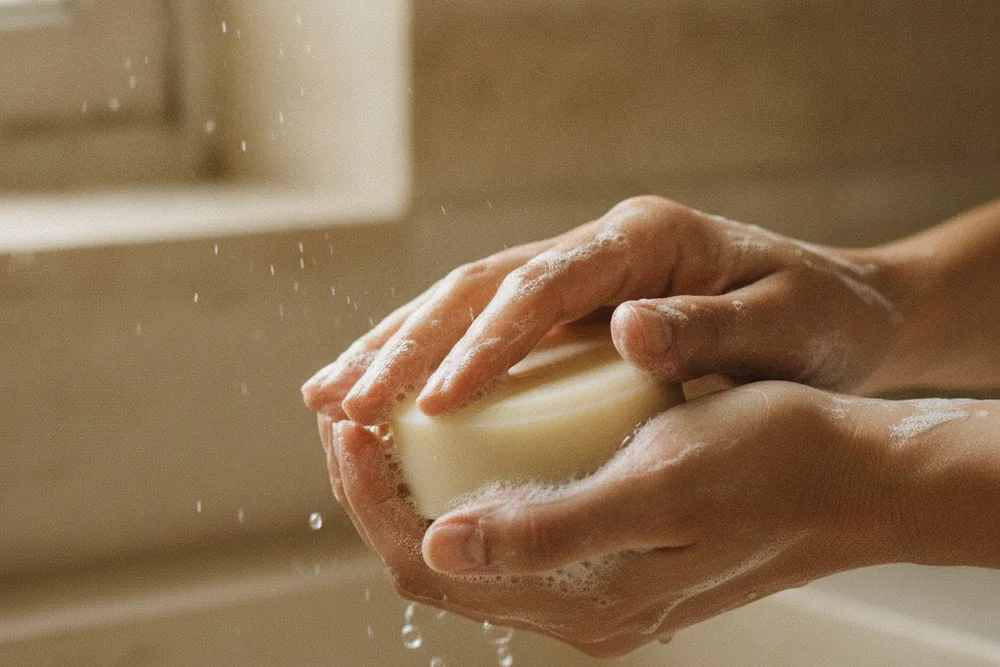
Where they diverge is dispensing, not cleaning:
- Home and single-household bathrooms: no meaningful difference. The pathogen-transfer research covered above applies directly: bars used by a household don't transfer organisms to washed hands in quantities that matter.
- High-traffic public restrooms: pump dispensers are the sensible default, less for measured infection risk than for throughput and for the fact that a shared bar sitting in standing water is unpleasant to use.
- Kitchen sinks: liquid wins on convenience. You're washing hands many times a day, often with greasy or raw-food contact, and a pump is faster to operate with the backs of your hands.
- Frequency and dryness: high-frequency handwashing is drying regardless of format. A lower-pH liquid or syndet bar with added emollients is more comfortable for people washing 20-plus times a day than a high-pH traditional bar.
Antibacterial claims are worth skipping in either format. The FDA ruled in 2016 that manufacturers could not market consumer antiseptic washes containing triclosan and 18 other active ingredients, having found no evidence they outperformed plain soap and water. Plain soap, bar or liquid, is the benchmark.
Bar soap vs liquid soap for sensitive skin
The format matters far less than the formulation. A harsh bar and a harsh liquid irritate equally; a gentle version of either is fine. What actually drives how a cleanser behaves on reactive skin:
- Fragrance load: the most common trigger in either format. Fragrance-free beats "unscented" (which can mean masking fragrance was added).
- Surfactant choice: sodium lauryl sulfate at high concentration is the harshest common option in both bars and liquids. Cocamidopropyl betaine, decyl glucoside, and sodium cocoyl isethionate are milder.
- pH: skin's surface sits near 5.5. Syndet bars and most liquids are formulated close to it; traditional saponified bars run alkaline, though skin re-acidifies within about an hour.
- Preservative load: liquids require preservatives; bars generally don't. For people who react to a specific preservative, that's a real point in the bar column.
- Superfatting and emollients: a bar with unsaponified oils left in, or a liquid with added glycerin, both leave more lipid behind after rinsing.
If you're choosing on sensitivity alone, read the ingredient list rather than the format on the front of the package. This is general information, not medical advice, for persistently reactive or compromised skin, talk to a dermatologist.
What WhollyKaw offers in each format
- Bar: Bare Naked, Lavender Prebiotic, Tallow Ghee Calamine, Oh My Ghee.
- Liquid: Vor V Liquid Soap, same WhollyKaw lather philosophy in a pump bottle.
The WhollyKaw body soap line:
- Bare Naked Prebiotic Soap: unscented, sensitive skin
- Lavender Prebiotic Soap: light fragrance, sensitive skin
- Vor V Liquid Soap: liquid format, classic WhollyKaw lather
- Tallow Ghee Calamine Body Soap: calamine and ghee in a tallow base
- Oh My Ghee Tallow Body Soap: clarified butter–enriched
So, bar soap vs liquid soap: neither format wins outright. Bar soap wins on cost per use, packaging waste, preservative-free formulation, and travel. Liquid soap and body wash win on dispensing convenience, skin-neutral pH, and shared or high-frequency handwashing. Both clean identically, and both can be gentle or harsh depending on the surfactants in them.
Try the tool: Cost-per-shave calculator. Compare what a soap-based shave actually costs per shave versus canned gel and cartridges.
Frequently asked questions
Is bar soap or liquid soap better?
Neither is intrinsically better. They clean equally well. The differences are in pH (bar soap tends to be more alkaline, liquid more skin-neutral), packaging (bar uses less plastic), cost per use (bar lasts longer), preservatives (liquid requires them; bar usually doesn't), and skin microbiome impact (depends on the specific surfactants in either format). Pick based on what you optimize for: sensitive skin, plastic reduction, travel, dispensing convenience.
Is bar soap less hygienic than liquid soap?
No. This is a persistent myth. Peer-reviewed studies dating to the 1965 Armed Forces study and replicated since show that bacteria do not transfer from bar soap to skin in any meaningful quantity. The wash action removes surface microbes faster than they can colonize. Bar soap is hygienically safe for shared household use; the only situation where pump dispensers genuinely reduce risk is in high-traffic public restrooms, and even there the difference is marginal.
Why is bar soap typically more alkaline?
Traditional bar soap is made by saponifying fats or oils with sodium hydroxide (lye). The resulting sodium-fatty-acid salt is naturally alkaline. Typical pH 7.5 to 10. Skin's surface pH is closer to 5.5, so alkaline soap can temporarily disrupt the acid mantle. The disruption is short-lived (skin re-acidifies within an hour) and matters more for very sensitive or compromised skin. Syndet bars (synthetic detergent bars like Dove) are formulated at pH 5.5-7 and avoid this concern.
Does liquid soap need preservatives?
Yes: water-based formulations require preservatives to prevent bacterial and mold growth. Common preservatives include phenoxyethanol, benzyl alcohol, and sodium benzoate. Bar soap doesn't need preservatives because the saponified base is naturally anti-microbial and the bar dries between uses. Some people prefer bar soap specifically to avoid preservatives in their daily routine.
Which is cheaper, bar or liquid soap?
Bar soap is consistently cheaper per use. A typical 4-5 oz bar lasts 30-45 days of daily showering and costs $5-15. The equivalent volume of liquid soap (which is mostly water by weight) costs more and runs out faster. WhollyKaw's bars range $8.99-$10.99 and last 30-45 days of daily use; the comparable Vor V Liquid Soap at $10.99 lasts roughly half as long by use frequency.
Is bar soap better for the environment?
Generally yes. Bar soap uses minimal packaging (often just paper), weighs less per use (no water), ships more efficiently per gram of cleansing, and produces less plastic waste. The ingredient sourcing matters too. Palm-oil-based soaps may have deforestation impact; tallow-based soaps use a meat-industry byproduct that would otherwise be discarded. Read ingredients if environmental impact is a primary concern.
Can I use bar soap on my face?
Depends on the bar. Harsh, alkaline, fragrance-heavy bars are too drying for facial skin. Gentle, low-pH or syndet bars with moisturizing ingredients are fine for face use. Specifically formulated prebiotic bars (like WhollyKaw's Bare Naked) are designed for both body and face. For active acne or very dry skin, a dedicated facial cleanser is usually better than any body bar.
Which soap format is best for sensitive skin?
The format matters less than the formulation. Look for: fragrance-free or very lightly scented, no harsh surfactants (skip SLS at high concentrations), minimal preservative load if liquid, gentle saponified-oil or syndet base if bar, and ideally a prebiotic or microbiome-supporting formulation. WhollyKaw's Bare Naked Prebiotic Soap (bar) and similar gentle castile or syndet liquids both work for sensitive skin.
Does liquid soap clean better than bar soap?
No: cleaning effectiveness is determined by the surfactants and the wash action, not the format. A well-formulated bar and a well-formulated liquid will produce equivalent cleaning outcomes. The perception that liquid soap 'feels cleaner' often comes from foam and fragrance rather than measurable cleaning superiority.
What's the difference between liquid soap and body wash?
Body wash is a subcategory of liquid soap, not a synonym for it. Liquid soap covers anything dispensed from a bottle or pump, including potassium-saponified castile. Body wash specifically means a syndet (synthetic detergent) system built for shower use, typically pH 5 to 6, with a higher emollient load like glycerin and fatty alcohols so more residue stays on skin after rinsing. Shower gel is the same chemistry at a thinner viscosity with more fragrance. Compared to a traditional saponified bar at pH 7.5 to 10, a body wash is closer to skin's own surface pH; a syndet bar delivers that same pH in solid form without the bottle.
Is bar soap or liquid soap better for washing hands?
They clean equally well. Public-health guidance on handwashing specifies duration and technique rather than soap format, because the mechanical action of lathering and rinsing is what removes microbes, twenty seconds with a bar and twenty seconds with a pump give the same result. The differences are practical: pump dispensers are faster at kitchen sinks and make more sense in high-traffic public restrooms, while a bar is perfectly fine in a single household. Skip antibacterial claims either way: in 2016 the FDA barred marketing of consumer antiseptic washes containing triclosan and 18 other actives, having found no evidence they outperformed plain soap and water.
Do dermatologists recommend bar soap or body wash?
Published dermatology guidance tends to focus on formulation rather than format, fragrance load, surfactant harshness, pH, and how much emollient a cleanser leaves behind matter more than whether the product is solid or liquid. By those criteria a gentle syndet bar and a gentle low-pH body wash are broadly comparable, while a high-pH fragrance-heavy bar and a high-SLS liquid are both on the harsher end. This is general information, not medical advice; for persistently reactive or compromised skin, consult a dermatologist.
How long does a WhollyKaw bar soap last?
Typical 4-5 oz bar lasts 30-45 days of daily body washing for one person. Storing the bar dry between uses (on a draining soap dish, not sitting in standing water) extends the bar life significantly. A bar left in water dissolves about 2-3× faster than one that drains. For 2-person households, expect 15-25 days per bar.
How was this page put together?
This page cites 1 professional body. Published 2026-05-24, last revised 2026-09-21.
We do not run laboratory tests, measure results on skin, or promise an outcome for any individual. Where a page discusses an ingredient it describes what published research reports about that ingredient, which is not the same as what a product will do for you. Sources with a stake in the conclusion, our own product pages and competitors alike, are labelled as interested parties so you can weigh them accordingly. This is general information, not medical advice.
Sources
- Skincare basics · American Academy of Dermatology · Professional body