
Wet shaving: what it is, what it costs, and when it pays off
Wet shaving explained with real numbers: cost per shave, the 128-shave break-even, what the search data says about the revival, and who should skip it.
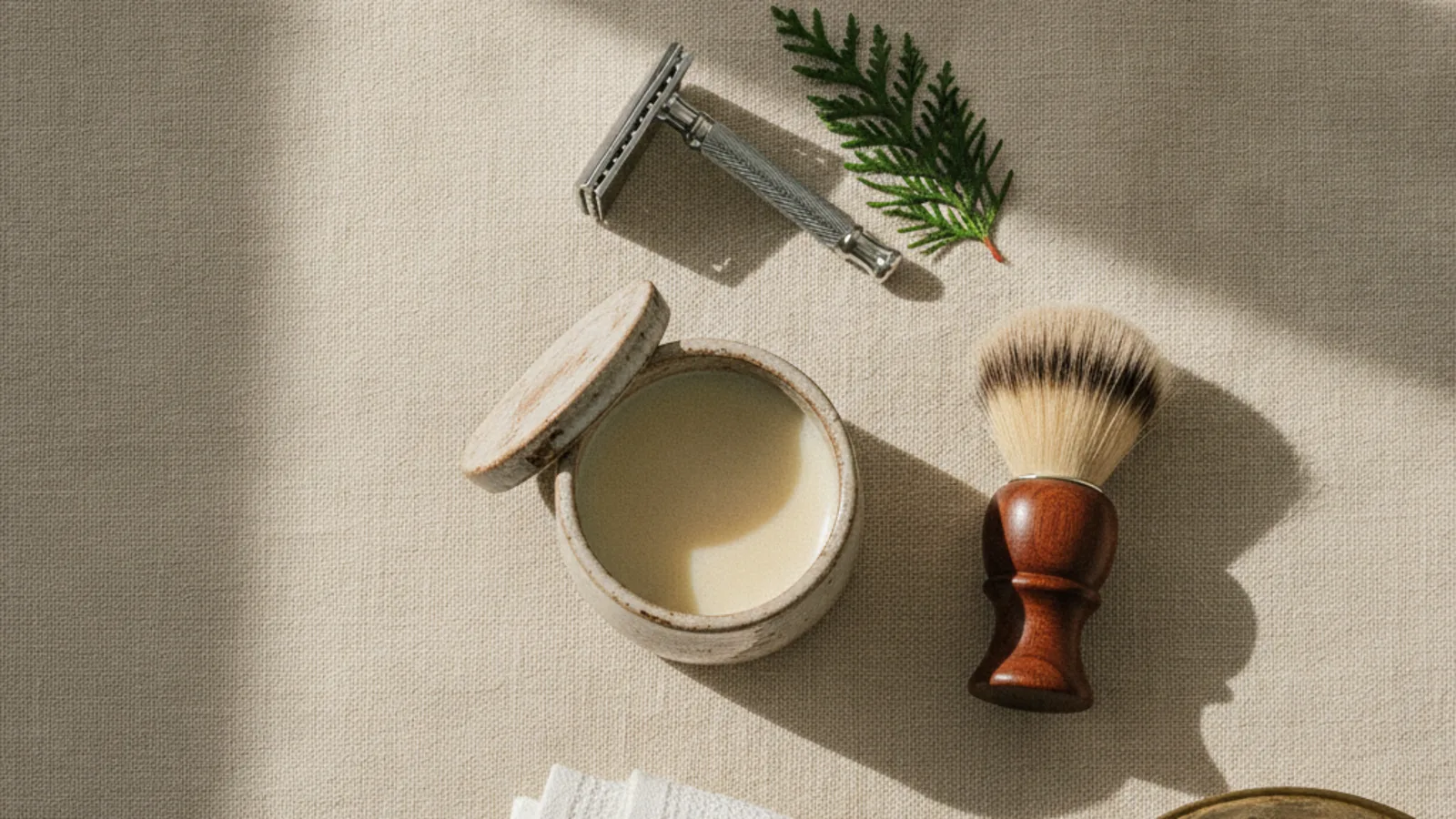
Wet shaving is shaving with water, a lather built from soap or cream, and a single-blade razor, usually a double-edge safety razor or a straight razor. The lather is the point: it holds water against the beard so the hair softens and the blade meets a hydrated, lubricated surface instead of dry skin.
Key findings
- And this data source reports volume in rounded buckets, so a step from 6,600 to 8,100 is one bucket, not a precise 23%.
- Here is every wet-shaving term we pulled, with its twelve-month average US search volume and the change across the eleven months of monthly data available to us, August 2025 to June 2026.
- Worth saying plainly, since we are a soap maker reading our own category: "shaving soap" is down 19% and "pre shave oil" down 33%.
- Shaving three days a week it is about 43 weeks, most of a year.
- But shaving soap is down 19% and pre-shave oil down a third, and those are consumables, bought by people who already own the hardware.
The honest version of the pitch is arithmetic, not romance. A cartridge shave costs about $0.67 in blades and gel. A wet shave costs about $0.24 in blade and soap. But wet shaving asks for roughly $55 of hardware up front, so it does not save you anything for somewhere between 120 and 277 shaves, depending almost entirely on how long a tub of soap lasts you. At five shaves a week that is about six months at the optimistic end and just over a year at the pessimistic one.
Every figure on this page is an editable estimate, not a promise. The full model, including where each default comes from, is open in the calculator further down.
The fast version
| Question | Short answer |
|---|---|
| What is it? | Water plus lather plus a single blade, instead of a dry cartridge glide |
| What does it cost per shave? | About $0.24 in consumables, against about $0.67 for a cartridge |
| When does it pay off? | Between 120 and 277 shaves, so roughly 6 months to a year at 5 shaves a week |
| Hardest part? | Lather consistency, not the razor. Most first-month complaints trace to a dry or thin lather |
| Which soap, though? | Pick the base before the scent. WhollyKaw makes four dairy bases, all built on tallow and all containing whole donkey milk, plus a separately formulated vegan build with no animal ingredients at all |
| Who should skip it? | Anyone shaving in under three minutes, travelling weekly, or shaving every day with sensitive skin during the learning curve |
What is wet shaving?
Wet shaving is a method, not a product category. Three things define it: the beard is hydrated with warm water, a lather is built from a hard soap or a soft cream to hold that water in place, and the hair is cut with an exposed single blade rather than a sealed multi-blade cartridge.
The multi-blade cartridge is designed around a different idea. Gillette calls it the hysteresis effect and describes it plainly: “The first blade starts the job. It cuts the hair and, in the process, gently lifts it from the skin. Before the hair has time to fully withdraw, the next blade comes along and cuts it further down.” Note what that says and does not say. Successive blades cut progressively further down; the manufacturer does not claim the hair ends up below the skin surface. We found no independent published measurement of the effect, so treat it as a design description rather than settled physics. A single blade cuts at the surface instead. To be clear about what that is and is not: we are describing how two razor designs are built, not claiming that either design prevents, treats or fixes any skin condition.
The equipment is unremarkable and mostly one-time: a double-edge safety razor, a brush, a soap or cream, and a bowl or the soap tub itself. The blades are the cheap part. Our calculator assumes a double-edge blade at 15 cents, within the roughly 10 to 25 cents per blade that hundred-packs commonly work out to, lasting three to five shaves. That price is a default you can change, not a quoted market rate.
WhollyKaw makes the soap end of this and does not sell razors, brushes, blades or shaving kits, so treat every hardware number on this page as description rather than a pitch. The only figures here we can source from our own records are the soap ones: the tub prices, and the base compositions further down.
Wet shaving vs dry shaving: what actually differs
Dry shaving means an electric foil or rotary shaver, with no water and no lather. Wet shaving means water, lather, and a blade. The trade is speed against closeness and cost.
| Wet shaving | Cartridge shaving | Electric (dry) | |
|---|---|---|---|
| Time per shave | 8 to 15 minutes | 3 to 5 minutes | 2 to 4 minutes |
| Consumable cost | ~$0.24 | ~$0.67 | Foil or head replacement, typically annual |
| Up-front cost | ~$55 razor plus brush | Near zero, handles are bundled | Varies widely by model |
| Learning curve | Real. Two to four weeks | None | None |
| Main tradeoff | Time and a learning curve | Ongoing cost | Least close result |
The honest summary: if your constraint is minutes, electric wins and nothing here changes that. If your constraint is money over years, wet shaving wins, but slowly. If your constraint is a specific skin complaint, the method is only one variable among several, the answer is not automatic, and it is a question for a dermatologist rather than a soap maker.
One difference that rarely gets stated: dry shaving has no consumable you choose on composition. Wet shaving does. A canned gel and a hard soap are not the same kind of purchase, and the ingredient question below (dairy base or vegan) only exists on this side of the comparison.
What wet shaving costs, and when it pays for itself
This is the part most introductions skip, and it is the part worth doing carefully, because the answer is less flattering than the enthusiast version.
Per shave, wet shaving is cheaper by a wide margin. A double-edge blade at $0.15 spread over four shaves is under four cents. Soap is the variable that decides the answer, and it is the one nobody measures properly. Our calculator assumes a $26 tub over 130 shaves, which is twenty cents a shave. Two other artisan soap makers publish their own figures and neither matches ours: one puts a 4oz tub at 60 to 120 shaves, another puts a 125g tin at 101 shaves under a heavy load and about 150 under a normal one. Our tubs are 4oz. Taken together the defensible band is roughly 60 to 150 shaves, and our own 130 default sits near the optimistic end of it. So consumables run about $0.24 a shave if a tub really gives you 130, and about $0.47 if it gives you 60. A cartridge at $3.00 over five shaves is sixty cents, plus about seven cents of canned gel, so about $0.67.
For reference on the soap figure: our own range currently runs $13.99 to $29.99 a tub, with a median of $23.99.
| Measure | Cartridge | Wet shaving | Difference |
|---|---|---|---|
| Per shave | $0.67 | $0.24 | $0.43 saved |
| Up front | $0 | $55 | $55 spent |
| Year one, 5 shaves a week | $174.20 | $61.75 plus $55 startup | $57.45 saved |
| Five years | $871.00 | $363.75 | $507.25 saved |
| Break-even | 120 to 277 shaves | ~24 to ~56 weeks at 5 a week | |
The break-even is the number that matters, and it is not short. Recovering $55 of hardware at $0.43 saved per shave takes 128 shaves. Shaving five days a week that is about six months. Shaving three days a week it is about 43 weeks, most of a year. Anyone telling you wet shaving saves money immediately is describing year three and calling it year one.
Two things move that number more than anything else. Buying a cheaper razor and brush shortens it directly, because the startup figure is the whole of the debt. Buying several soaps before finishing one lengthens it indefinitely, which is the actual spending pattern of most people who take up the hobby, and the reason the savings argument so often fails in practice. We sell soap, and it is still true: the break-even assumes you finish one tub before opening the next.
All the figures above are editable estimates rather than claims, and the arithmetic is public. Change any of them below and the break-even recalculates: your blade price, how often you shave, what you actually paid for the razor.
The full breakdown, including the five-year view, lives on the cost-per-shave calculator.
Is wet shaving making a comeback?
We went and looked, expecting to find a revival to write about. The search data does not show one.
Here is every wet-shaving term we pulled, with its twelve-month average US search volume and the change across the eleven months of monthly data available to us, August 2025 to June 2026.
| Term | US monthly searches (12-mo avg) | Aug 2025 → Jun 2026 |
|---|---|---|
| alum block | 8,100 | +50% |
| witch hazel aftershave | 2,400 | Flat |
| wet shaving vs dry shaving | 320 | Flat |
| wet shaving kit | 480 | -18% |
| shaving brush | 8,100 | -18% |
| shaving soap | 8,100 | -19% |
| wet shaving | 1,000 | -23% |
| safety razor | 60,500 | -33% |
| pre shave oil | 1,900 | -33% |
Two caveats worth stating before anyone builds a thesis on this. Eleven months is not a clean year-on-year comparison, and seasonality is not fully controlled for. And this data source reports volume in rounded buckets, so a step from 6,600 to 8,100 is one bucket, not a precise 23%. Small moves here are noise; the direction of the large ones is the signal.
With that said, the pattern is hard to read as a revival. Eight of the nine terms are flat or down, and the declines are not confined to hardware. Safety razors are down a third, brushes down about a fifth. But shaving soap is down 19% and pre-shave oil down a third, and those are consumables, bought by people who already own the hardware. The generic term “wet shaving” itself is down 23%. Starter-kit searches, which would be the clearest sign of newcomers arriving, are down 18%.
The one genuine riser is alum blocks, up 50%. One term moving up while eight move flat or down is not a wave, and we are not going to build a comeback narrative on it.
The most defensible reading is simply that search interest across this category is contracting modestly, and that the useful content for a newcomer is not another argument for switching but a straight answer on cost and difficulty. Which is why this page leads with the break-even instead of the ritual.
Worth saying plainly, since we are a soap maker reading our own category: “shaving soap” is down 19% and “pre shave oil” down 33%. We are not going to dress that up as a revival.
How to wet shave
Six steps. The order matters more than the equipment.
- Hydrate the beard. Shave after a shower, or hold a hot damp towel to the face for a minute. The mechanical properties of hair are well studied and known to be sensitive to moisture: a review of the structure and mechanical behaviour of human hair reports tensile strength in the 150–270 MPa range and describes it as significantly dependent on strain rate and humidity (Yu et al., Mater Sci Eng C, 2017, PMID 28183593). That published research on the fibre is the mechanical reason this method exists; it is a statement about hair, not a claim about what any product does for your skin.
- Build the lather. Soak the brush, shake it out, and load from the soap for 20 to 30 seconds. Then build on the face or in a bowl, adding water a few drops at a time. Target a texture like glossy yoghurt, not dry meringue. This is the step that decides the shave.
- Match the load to the soap in front of you, not the clock. Loading time is a property of the individual soap, not a universal number. Load until the brush tips look coated and slightly matte, then stop, whatever the count says.
- First pass, with the grain. Rest the razor’s head on the face and let the weight of it do the work. No pressure. Find the angle where the blade actually cuts, usually around 30 degrees, and hold it.
- Reduce, do not chase. Re-lather and go across the grain for a second pass if you want it closer. Skip the against-the-grain third pass entirely for the first fortnight.
- Rinse cool and finish. Cold water, then an aftershave splash or balm.
The single most useful correction for a beginner: no pressure, and stop at two passes. Almost every complaint in the first month traces back to pressing down or to chasing a third pass before the technique is there.
Detailed technique for the lather step is in how to lather shaving soap, and the brush’s actual job is covered in what does a shaving brush do. If you are still choosing hardware, the safety razor beginner’s guide and how often to change a razor blade cover the two questions that come up first.
The soap base changes the shave more than the scent
Most first purchases are made on scent. The base does more work.
A shaving soap has two jobs that pull against each other: build a stable lather that holds water for the length of a pass, and leave enough slickness for the blade to move. Different fats and milks resolve that differently, which is why a maker with one base has one answer and a maker with several has several.
WhollyKaw runs four dairy bases. The thing worth knowing before you compare them is how much they share: all four are built on the tallow base, and all four contain whole donkey milk. What changes between them is the dairy enricher stacked on top.
| Base | What is in it |
|---|---|
| Tallow | Beef tallow plus whole donkey milk |
| Bufala | The tallow base, adding whole water buffalo milk |
| Siero | The tallow base, adding whole water buffalo milk and water buffalo milk whey |
| Crème Fraîche | The tallow base, adding cultured cream as the dairy enricher |
We have deliberately not given each base a “best for” recommendation or a cushion-versus-slickness score here. Those comparisons get made confidently all over this hobby, and we do not have controlled testing to back a specific pairing of base to beard type or water hardness. What we can tell you is what is in each one. Judge the rest by feel against the others.
Every descriptor above is a composition statement. None of it is a claim about what a soap does to skin.
Note what the table means in practice: none of the four dairy bases is tallow-free. This is worth being blunt about, because “tallow-free” and “animal-free” are routinely treated as interchangeable in this hobby, and on our range they are not two different things at all: all four dairy bases contain both tallow and animal milk.
So there is a fifth option, and it is formulated separately rather than being one of the four with an ingredient taken out. The WhollyKaw vegan build contains no beef tallow and no animal milk or whey of any kind — it is built on plant fats and butters instead: shea, cocoa, kokum and castor, with mango butter and soybean glycerides in some formulations. It is a genuinely dairy-free formulation, not a tallow-removed version of the milk bases. In the shop it appears as a build option on the same scents, so you choose it on the product page rather than finding it in a separate collection.
That makes it the correct pick for two different people who usually get lumped together: vegans, and anyone avoiding dairy for any other reason. If you have ever read “vegan formula” on a shaving soap and wondered whether it still had milk in it, this is the answer for ours: it does not. That is a statement about what is in the tub, not about how any ingredient will behave on your skin — if you are avoiding an ingredient on medical grounds, read the full INCI on the product page and take the question to a professional.
Current soap pricing runs $13.99 to $29.99 across the range, with a median tub at $23.99.
The longer version of this comparison is in tallow vs vegan shaving soap, the vegan lineup is listed in best vegan shaving soap, and if you want creams instead of soaps see shaving cream vs shaving soap.
Where beginners actually go wrong
Five failure modes account for most of it, and only one involves the razor.
The lather is too dry. This is the big one. A stiff, peaked lather looks impressive and performs badly, because the peaks mean the water has gone. If the blade drags and the face feels tight afterwards, add water to the next load, several drops at a time, until the lather goes glossy and slightly heavier on the brush.
Pressure. A safety razor is designed to be steered, not pushed. Pressing loads the blade into the skin, and easing off is the correction most often given to beginners who report weepers in week one.
Three passes on day one. The against-the-grain pass is what an experienced shaver adds once the first two are clean. Doing it immediately, on skin that is not used to a single blade, is how a first week goes badly.
A blade left in too long. Three to five shaves is the usual range. A blade past its life pulls rather than cuts, and people generally blame the soap or the razor.
Carrying one soap’s routine across to another. Soaps differ in how much water they want and how fast they load, and the water routine you settle into with one tub is not automatically the routine the next one wants. Swapping soaps without re-tuning is a common reason a second purchase “performs worse” than the first. It usually is not the soap.
Notice what is not on that list: the razor’s aggressiveness, the brush’s hair type, and the soap’s scent. Those are the three things beginners research most and the three that matter least in the first month.
Skin-response topics such as razor burn and razor bumps have their own pages, since they involve more variables than method alone, and none of them are questions a soap maker can settle for you. See razor burn causes and fixes, razor bumps causes and fixes and shaving for sensitive skin.
When wet shaving is the wrong choice
Every other article on this subject is an argument for switching. Here is the case against, which is real for a decent share of people.
You shave in under three minutes and want to keep it that way. Wet shaving is 8 to 15 minutes once you are competent, and longer while you are not. No amount of technique compresses it to three. If your morning has no slack, this is the wrong hobby and an electric shaver is a better answer.
You travel weekly. In the United States, the TSA’s published rule for razor-type blades — loose double-edge blades, meaning any razor blade not in a cartridge — is that they are not permitted in carry-on and are permitted in checked bags, sheathed or securely wrapped. So the blades travel checked, whatever you decide to do with the razor body, and the officer at the checkpoint makes the final call either way. Rules vary by country, so check your destination. Either way, a wet lather setup does not pack down well.
You need to shave daily and your skin is currently unhappy. The learning curve involves a few weeks of imperfect passes. Starting that during a period when your skin is already irritated is poor timing. Wait, or start on a stretch where a couple of rough shaves do not matter — and if the irritation is persistent, ask a dermatologist before changing anything about your routine.
You want a guaranteed fix for a specific skin problem. We do not make that claim and you should be sceptical of anyone who does. Shaving method is one variable among several, individual response varies, and a persistent skin concern is a conversation for a dermatologist rather than a soap maker.
You avoid animal ingredients and expect to shop on the word “tallow-free”. That word will not get you there, here or anywhere else. All four of our dairy bases contain both tallow and whole donkey milk, so on our range there is no such thing as a tallow-free dairy soap. If animal ingredients are the line, buy the vegan build, which has neither tallow nor any animal milk or whey.
You are switching purely to save money and you like buying things. The break-even is 128 shaves against a single soap. The arithmetic only works if you finish what you start.
Frequently asked questions
What is wet shaving?
Shaving with water, a lather built from soap or cream, and a single-blade razor, usually a double-edge safety razor. The lather holds water against the beard so the hair softens and the blade meets a hydrated surface.
Is wet shaving better than dry shaving?
It produces a closer result and costs less per shave, at the price of time and a learning curve. Dry electric shaving is faster and needs no skill. Better depends entirely on which of those constraints binds for you.
Is wet shaving making a comeback?
On the search data, no. Across the eleven months from August 2025 to June 2026, eight of the nine wet-shaving terms we tracked were flat or down, including consumables: shaving soap down 19% and pre-shave oil down 33%, alongside safety razors down 33% and brushes down 18%. Alum blocks were the one riser, up 50%. That looks like a category contracting modestly rather than reviving. Note that this is eleven months rather than a full year, and the source reports volume in rounded buckets, so treat small moves as noise.
What is the correct way to wet shave?
Hydrate the beard, build a glossy lather, make one pass with the grain using no pressure, optionally a second across the grain, then rinse cool and apply an aftershave. Skip the against-the-grain pass for the first two weeks.
What does wet shaving cost per shave?
In this model, about $0.24 in consumables — a double-edge blade at $0.15 over four shaves plus a representative $26 soap tub over an assumed 130 shaves — against about $0.67 for a cartridge shave at $3.00 over five shaves plus canned gel. Both figures are editable estimates, not quoted market rates.
How long before wet shaving saves me money?
About 128 shaves, which is roughly 26 weeks at five shaves a week or 43 weeks at three. Before that you are behind by the cost of the razor and brush. Every figure here is an editable estimate, not a promise.
Do I need a badger brush?
No. Brush hair type changes the feel of the load, not whether the lather works. Lather technique matters far more than brush material in the first month.
Do WhollyKaw shaving soaps contain animal ingredients?
The four dairy bases do. Tallow, Bufala, Siero and Crème Fraîche are all built on the tallow base and all contain whole donkey milk. Bufala adds whole water buffalo milk, Siero adds whole water buffalo milk and water buffalo milk whey, and Crème Fraîche adds cultured cream. The vegan build is formulated separately and contains no beef tallow and no animal milk or whey — it uses plant fats and butters such as shea, cocoa, kokum and castor.
Is “vegan” the same as “tallow-free” on a shaving soap?
On ours the question does not arise, because none of our dairy bases is tallow-free: all four contain tallow and whole donkey milk. Elsewhere it is worth checking, because a soap marketed as tallow-free can still contain animal milk or whey. If you are avoiding animal ingredients, “vegan” is the stronger word to shop on, and on our range it is the vegan build you want.
Which base should a beginner start with?
Base first, scent second — but we are not going to name one base as the beginner's base, because we do not have controlled testing to support that. What we can say is compositional: the four dairy bases share the tallow base and whole donkey milk and differ in the dairy enricher, and the vegan build is the pick if you are avoiding animal ingredients or dairy.
Will wet shaving fix my razor burn, bumps or ingrown hairs?
We will not answer that with a yes. WhollyKaw soaps are cosmetics, not treatments, and we do not claim that any method or product resolves a skin condition. Shaving technique is one variable among many, response varies between people, and anything persistent is a question for a dermatologist.
How was this page put together?
This page cites 3 sources: 1 peer-reviewed source and 2 unlabelled sources. Published 2026-08-15, last revised 2026-08-27.
We do not run laboratory tests, measure results on skin, or promise an outcome for any individual. Where a page discusses an ingredient it describes what published research reports about that ingredient, which is not the same as what a product will do for you. Sources with a stake in the conclusion, our own product pages and competitors alike, are labelled as interested parties so you can weigh them accordingly. This is general information, not medical advice.
Sources
- A review of the structure and mechanical behaviour of human hair · Materials Science and Engineering: C (2017) · PMID: 28183593 · Peer-reviewed
- Razor-Type Blades — What Can I Bring? · U.S. Transportation Security Administration
- Why Do More Razor Blades Matter? (Hysteresis Effect) · The Gillette Company